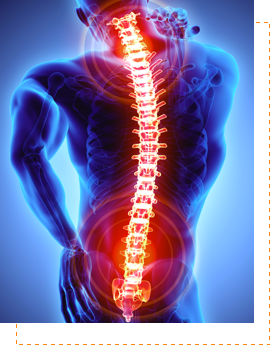
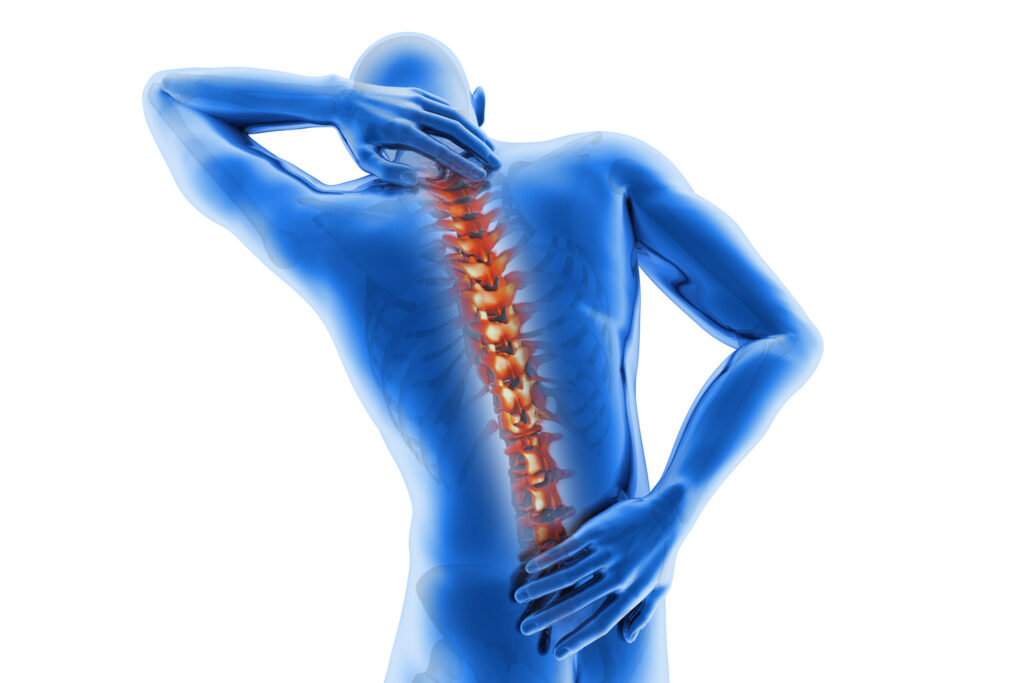
Spinal discs work as shock absorbers between your vertebrae and allow for everyday movements that cause you to bend, twist, and flex. Because these discs have a minimal blood supply, their reparative ability is limited. This means that once degenerative disc disease exists, there’s no bringing back what was lost.
However, this seemingly bleak condition can be treated with an all-inclusive treatment plan that may include physical therapy, acupuncture, or non-surgical treatments for degenerative disc disease and chronic back pain.
Symptoms and Causes of Degenerative Disc Disease
Your spinal discs will naturally break down over time. When damage is substantial, the term used to describe this condition is degenerative disc disease, which is associated with numbness, pain, and weakness in the area of the affected disc(s).
Often, the most severe pain occurs in the early stages of degenerative disc disease, with symptoms potentially receding over time. Treatment for this condition should include various helpful treatments through all stages of this condition to prevent further damage.
Causes for spinal disc degeneration vary in their source, as well as their effects on your discs and corresponding treatments. Drying out of a disc can occur due to aging, sports and daily activities can cause tears, and injuries can cause substantial swelling and instability of a disc.
All these circumstances can cause permanent damage to your spinal discs that will require some form of medical treatment. Non-surgical treatments for degenerative disc disease include intradiscal steroid injections, epidural steroid injections, and physical therapy.
Intradiscal Steroid Injections
This non-surgical treatment for degenerative disc disease is effective for a herniated (ruptured) or torn spinal disc, frequently associated with low back and leg pain. Some patients with a herniated or torn disc don’t respond well to traditional treatments like physical therapy. However, many do progress well with intradiscal steroid injections.
Epidural Steroid Injections
Epidural steroid injections are often beneficial for neck, mid-back, or low back pain patients. This pain is due to disc degeneration that may include protrusions, bulges, or herniations. This procedure is effective at reducing nerve inflammation and pain without surgery.
Physical Therapy
Integrating physical therapy into your degenerative disc treatment can complement other therapies. It may contribute to quicker symptom resolution as daily movements are incorporated into therapy. Working the muscles around your discs is important for regaining strength in your spine.
Stages of Degenerative Disc Disease
Of course, every patient will experience degenerative disc disease differently, but here is a general breakdown of the stages. This may give a general idea about where one falls on the spectrum and what to expect in the future.
Stage One:
Acute pain due to everyday wear and tear or injury and the initial struggle to perform daily activities without pain. Little to no effect on bone tissue; discs may tear, bulge, or lose fluid.
Stage Two:
A longer period of spinal instability. This may include intermittent back and neck pain, dry-out, or disc thinning. However, there is still little or no damage to bone structure.
Stage Three:
Bone changes like bone spurs put pressure on the spinal cord, further disc thinning.
Stage Four:
Little disc material remains, severe vertebral bone changes, and vertebrae may touch and move against each other, causing severe pain and the potential for rapidly progressing and permanent damage.
Have you been struggling with pain in your back and can’t find a solution? With non-surgical procedures performed by Dr. Alexander and his associates, relief from pain due to disc degeneration is just a phone call away. With one or more of our innovative non-surgical treatments, there is something for everyone to find. Contact us today for a free consultation.